- A Swiss GmbH starts at CHF 20,000 of fully paid capital – not a paper shell with a symbolic euro.
- At least one Swiss-resident person must be able to sign for the company – remote-only boards fail the register.
- 2026 canton rates still swing hard: Lucerne near 11.7%, Zurich and Bern near the top of the table.
What CHF 20,000 Actually Locks In
Under the SECO KMU guide, a GmbH needs CHF 20,000 of Stammkapital, split into shares of at least CHF 100, and that capital must be fully paid in cash or covered by a formal contribution in kind.
One member is enough. The company exists only after commercial-register entry, not when the notary stamps the deed. Commercial-register fees for a limited liability company run about CHF 420 as a basic fee, plus CHF 20 per signatory registration – before notary and advisory bills.
Liability stops at the company’s assets in ordinary cases. That is the legal bargain: paid capital plus public filing, not a free limited-liability sticker.
The Resident Signatory Rule Non-Residents Miss
Since mid-2015, Swiss company law has required that a GmbH can be represented by a person with Swiss domicile. That person is typically a managing director or director with signing authority, not a mailbox.
Foreign owners can hold 100% of the shares. The choke point is operational: someone resident in Switzerland must be able to bind the company and reach the shareholder and beneficial-owner lists. Nominee or fiduciary director fees become a recurring cost line, not a one-time setup trick.
2026 Canton Rates: Lucerne to Bern
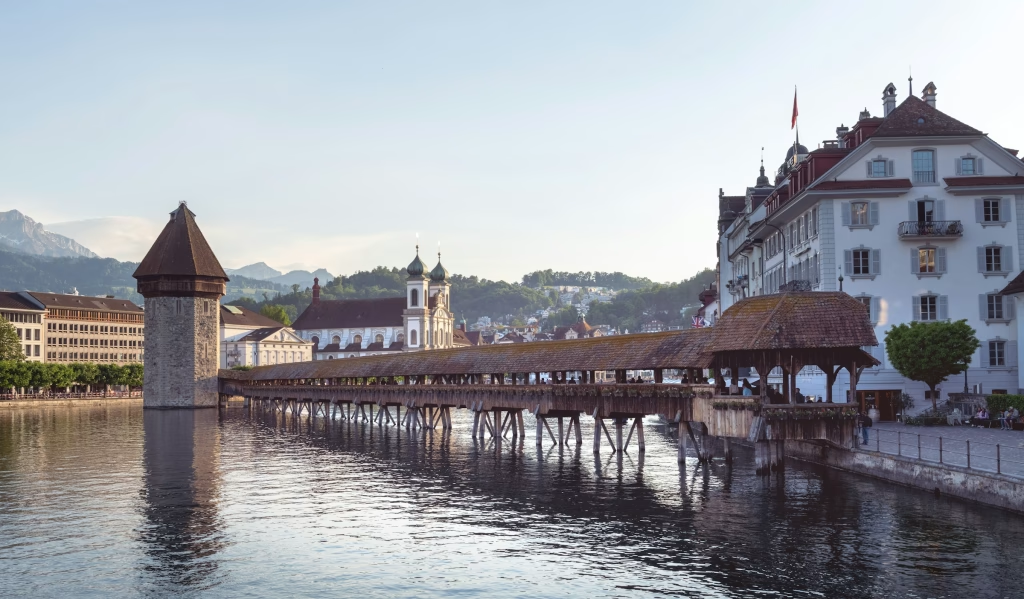
Federal plus cantonal plus communal profit tax still depends on seat. KPMG’s Swiss Tax Report 2026 puts effective ordinary rates at cantonal capitals roughly at Lucerne 11.66%, Zug 11.71%, Geneva 14.70%, Zurich 19.47%, and Bern 20.54%.
The national average sits near 14.4%. A GmbH in a low-tax Central Swiss seat and one in Bern are not the same product. Seat shopping without real management on the ground is a separate compliance risk advisers flag constantly.
Audit Opt-Out for Lean Teams
Companies that skip the ordinary-audit thresholds still face a limited audit by default. Under Art. 727a of the Code of Obligations, all members may waive that limited audit if the company averages no more than ten full-time employees.
The waiver applies only to future financial years and must reach the commercial register before the year starts, with recent annual accounts attached. Any member can later demand a limited audit again. Opt-out cuts auditor fees; it does not erase bookkeeping duties.
Bank Onboarding Is the Slow Gate
In practice – not as a statute – Swiss bank onboarding for foreign-owned GmbHs is strict and often stretches across several weeks. Expect beneficial-owner paperwork, source-of-funds questions, and back-and-forth on the Swiss resident signatory.
Register formation can finish while the account is still pending. Founders who treat “incorporated” as “banked” misread the real timeline that blocks invoices and payroll.
GmbH vs US LLC, Estonia, Bulgaria, UAE
A US LLC is cheap to form and flexible for US-centric ops, but it is not a Swiss substance story and does not replace Swiss banking or Swiss-facing contracts. Estonia’s e-residency stack is built for digital remote filing at low capital – a different product from a CHF-capital Swiss vehicle.
Bulgaria’s EU low-tax pitch still turns on real substance and ongoing compliance, as our Bulgaria 2026 guide maps out. The UAE free-zone or mainland company can be lighter on capital and fast on paper, yet the banking and substance questions simply move to another regulator.
Switzerland wins on brand, treaty network, and creditor comfort. It loses on absolute setup cost, resident-director friction, and the patience Swiss banks demand from non-resident owners.
Who a Swiss GmbH Actually Fits
The structure suits operators who need Swiss counterparties, Swiss employees, or a seat that lenders and clients recognize – and who can fund capital, a resident signatory, and weeks of bank KYC without treating those as surprises.
It is a poor match for founders hunting the cheapest EU shell or a pure holding label with zero Swiss footprint. For that brief, Estonia, Bulgaria, or a Gulf company usually closes the gap faster, with different trade-offs.